


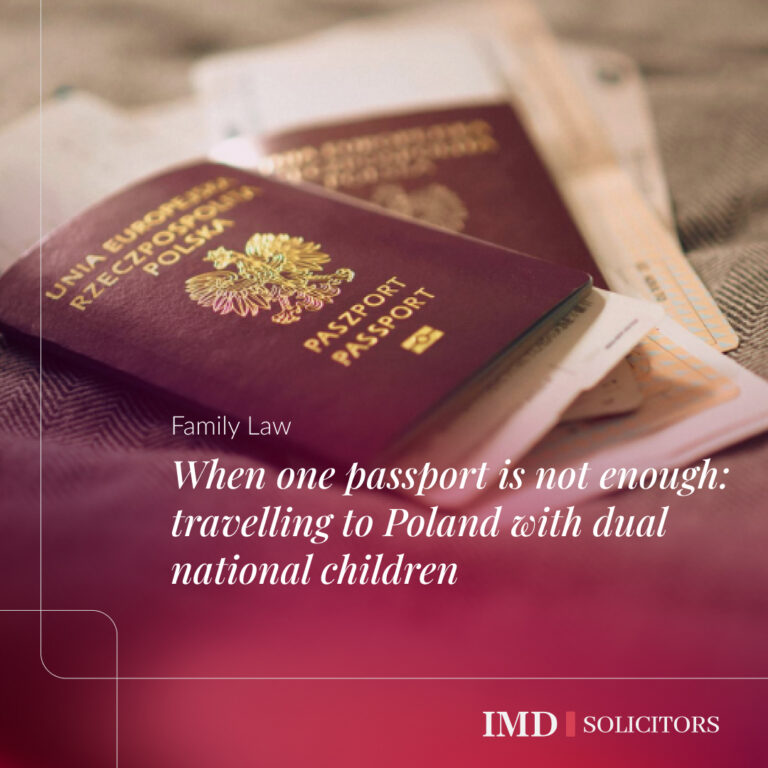

In recent weeks, there have been growing concerns about difficulties at Polish airports, particularly around checks of immigration status before boarding flights to the UK. While immigration is a topic in its own right, this article focuses on something slightly different, but just as important: travelling with children, especially those with dual nationality.
Many parents may not realise that a child born to a Polish parent automatically acquires Polish citizenship. This is based on the principle of ius sanguinis (citizenship by descent). Importantly, this applies regardless of whether the child has been formally registered as a Polish citizen or whether any Polish documents have ever been issued.
A British Passport Does Not Change the Child’s Legal Status
In practice, this can come as a surprise. It is very common, and entirely understandable, for parents to apply only for a British passport for their child. The process is straightforward, familiar, and usually does not require in-person appointments. However, from the perspective of Polish law, this does not change the child’s legal status.
When entering or leaving Poland, Polish authorities treat such a child as a Polish citizen. This means that border control officers may require the child to present a valid Polish passport, rather than relying solely on a British one. While this may not happen in every case, recent reports suggest that checks are becoming more consistent. Without the appropriate document, you may experience delays, additional questioning, or, in some situations, be prevented from boarding a flight.
The Legal Position Under Polish Law
This approach is rooted in Polish legislation, including the Act on Polish Citizenship (Dz. U. z 2023 r. poz. 1989) and the Act on Passport Documents (Dz. U. 2022 poz. 350). In simple terms, Polish citizenship takes precedence while the individual is in Poland, even if they also hold another nationality. From a legal perspective, the authorities are not treating the child as a dual national at that point, but simply as a Polish citizen.
There are also practical considerations to keep in mind. Applying for a Polish passport for a child is not always as quick or straightforward as the British process. It typically requires attending a consulate or passport office in person, and crucially, the consent of both parents. This can present difficulties where parents are separated, not in contact, or where one parent does not agree to the application.
If consent cannot be obtained, it may be necessary to apply to the court for permission. Where the child lives in England and Wales, the courts here can deal with such applications, although this will inevitably add time and cost. It is therefore sensible to address these issues well in advance of any planned travel.
What does this mean in practice?
- If your child has a Polish parent, they are likely a Polish citizen – even if you have never formally confirmed this.
- A British passport alone may not always be sufficient for travel to and from Poland.
- Border checks may be stricter than expected, particularly at departure.
- It is worth checking your child’s status well in advance of any trip.
- If needed, allow time to obtain a Polish passport or resolve any parental consent issues.
Prepare Early to Avoid Difficulties
Taking a little time to prepare can help avoid unnecessary stress at the airport and ensure that your journey goes as smoothly as possible.
Contact Us for Advice
We hope this overview helps you avoid unexpected complications when travelling. If you have any questions, or if you are experiencing difficulties obtaining the other parent’s consent, you are welcome to contact our office, and we will be happy to assist.
This article is for general information only and does not constitute legal or professional advice. Please note that the law may have changed since this article was published.
