Advice Centre

Travelling as a Dual British–EU Citizen: How ETA Rules Work in Practice
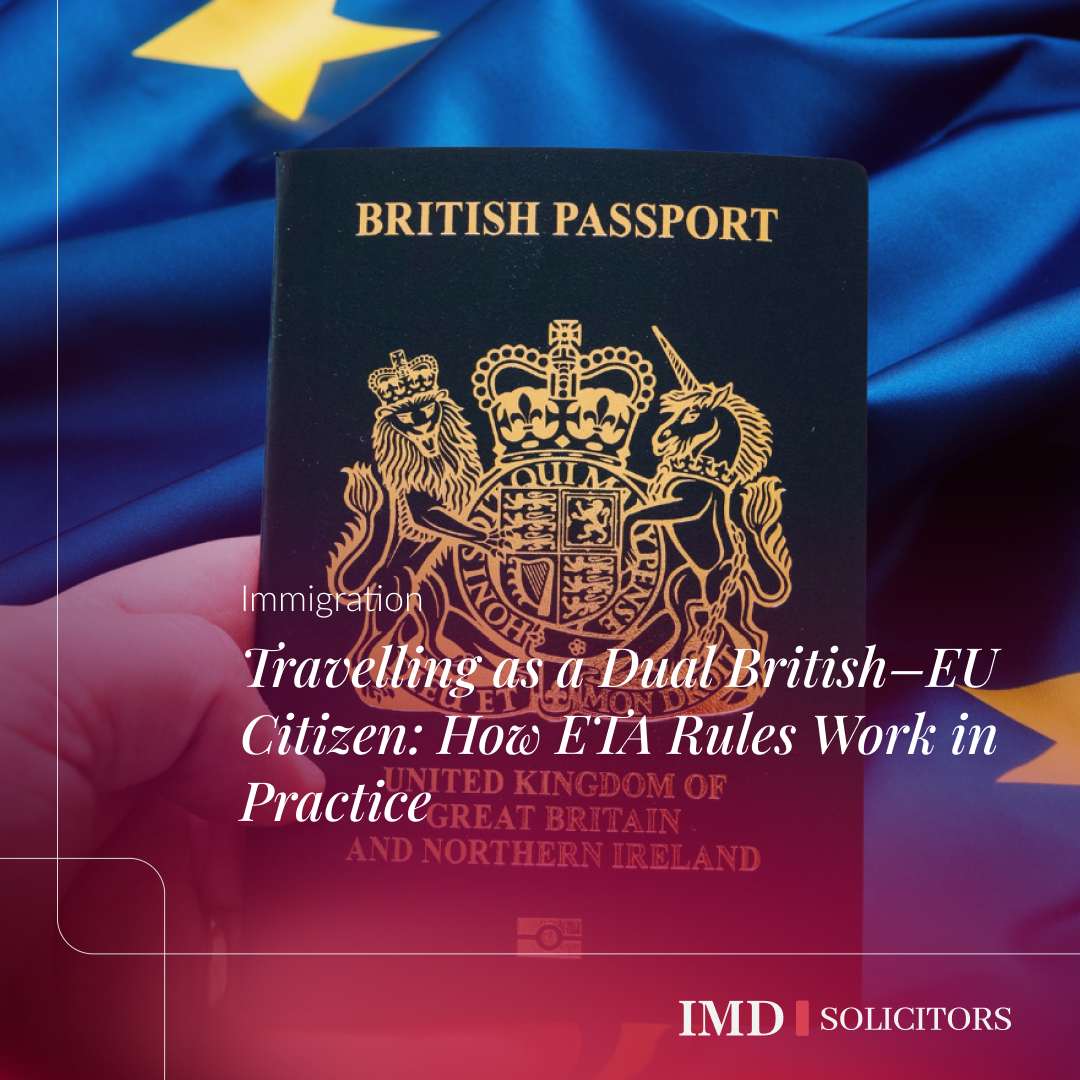
As the UK continues to modernise its border processes, many travellers are adjusting to new entry requirements, including the Electronic Travel Authorisation (ETA). However, dual British – EU citizens occupy a unique legal position, and misunderstandings, particularly by airlines, are increasingly common. This article explains how the rules work in practice, what documents dual nationals should use when travelling, and what to do if a carrier incorrectly insists that an ETA is required.
Do Dual British–EU Citizens Need an ETA?
The answer is simple: No.
British and Irish citizens are fully exempt from the ETA requirement. Once a person naturalises or registers as a British citizen, they no longer require immigration permission to enter or remain in the UK, and any prior immigration status, such as EU Settlement Scheme (EUSS) status, becomes void for the purposes of UK entry.
Despite this, confusion has arisen because travel systems used by airlines often do not automatically recognise dual nationality rights or the complexities of UK immigration law.
Proving Your Right to Enter the UK
Dual British – EU nationals can prove their right to enter the UK using one of the following:
- a valid British passport, or
- a valid Irish passport or Irish passport card, or
- a valid passport containing a Certificate of Entitlement to the Right of Abode.
This means you do not require a visa, an ETA, or any other form of advance permission.
Travelling as a Dual National: Two Distinct Sets of Rules
Dual nationals frequently need to prove two separate rights:
- Their right to enter the UK, and
- Their right to enter—and, if relevant, reside in—the EU.
This distinction becomes particularly important for dual citizens who live in an EU Member State. In such cases, the traveller may need to show evidence of EU residency to prove exemption from the “90 days in every 180” rule that applies to non-EU visitors.
For this reason, dual nationals are strongly advised to travel with:
- their valid British passport, and
- their valid EU passport.
You may need to show different passports at different stages of the same journey.
Which Passport Should You Use and When?
1. Travelling from the UK to the EU
Use your EU passport for your airline or carrier. This demonstrates that you are an EU citizen and do not require a visa, ETA, or ETIAS (once introduced) to enter the EU.
2. Travelling from the EU back to the UK
Use your British passport for airline check-in. This confirms your unconditional right to enter the UK and your exemption from ETA requirements.
If you live in the EU, you may also need to show your EU passport to demonstrate residency when departing.
3. At the border
- EU border control: show your EU passport.
- UK Border Force: show your UK passport.
Using the correct passport at the correct point avoids delays and reduces the likelihood of being challenged by carriers.
Problems with Airline Systems
Many airlines do not allow passengers to attach different travel documents to different legs of a return booking. These limitations often stem from:
- outdated system design,
- a desire to keep procedures simple for staff and passengers, and
- insufficient staff training on the rights of dual nationals.
As a result, travellers may find that:
- Online check-in for the return journey is not possible;
- The system wrongly insists that an ETA is required because only an EU passport is linked to the booking.
In these situations, travellers can usually resolve the issue by going to a check-in desk and showing their British passport. Airlines are obligated to accept this as proof that no ETA is required.
A common scenario involves travellers who have linked their EU passport to their return flight, leading the airline to insist incorrectly that an ETA is required for re-entry to the UK.
Option 1: Update the passport on your booking
Some airlines allow passengers to change the travel document mid-trip. If possible, attach your British passport once you arrive in the EU so the airline’s system recognises that you do not require an ETA.
Option 2: Check in at the airport
If you cannot update your travel document online, you may not be able to check in electronically. Instead, present your British passport at a staffed check-in desk.
If the airline still refuses boarding, it is acting incorrectly and may be liable for compensation. In such cases, reporting the incident is strongly recommended.
What you can do:
- contact Ryanair through Live Chat, and
- ask for your reservation to be split,
- allowing different documents to be used for each leg of the journey.
Looking Ahead: ETIAS from Late 2026
From late 2026, the EU will introduce the European Travel Information and Authorisation System (ETIAS). Once operational, this system will function similarly to the UK’s ETA.
For dual British–EU citizens, this will mean:
- EU passport → used for flights to the EU to avoid needing ETIAS
- British passport → used for flights back to the UK to avoid needing ETA
While booking two separate one-way flights can address document-matching problems, this option is often more expensive and less convenient.
To arrange a confidential consultation, please contact us at 0330 107 0107 or complete our online enquiry form.
Jarmila Entezari - Senior Associate